Webinar Highlights
The LFP battery material supply chain is a bottleneck controlled by a single country. Executives from Nano One and Worley discussed the risks this exposes and the opportunities it presents for those ready to act.
Hosted by Red Cloud Financial Services Inc.
Chapters
0:00 Nano One’s One-Pot Technology and LFP Market Opportunity
1:50 Nano One × Worley Partnership and Deployment Strategy
2:50 Candiac Facility, Scale-Up, and Commercial Readiness
4:00 Localizing Battery Supply Chains Outside China
5:20 Technology Package, EPCM Options, and Customer Flexibility
7:05 De-Risking Scale-Up and Cost Competitiveness
9:10 One-Pot Process Advantages: Lower CAPEX, OPEX, and Energy Use
11:25 What “Ready for Business” Means
12:10 Proven Process, Engineering Work, and Cost Estimates
13:00 Technology at Scale and Path to Sales
14:10 Adapting to Market Needs and Future Developments
15:05 Final Remarks
Transcript
A little bit about Nano One itself and our technology. We call it our One-Pot technology. This is a patented technology for the manufacturing of cathode active materials. Why are cathode active materials important? They represent between 40% to 60% of the cost of a lithium-ion battery cell. We’ve been scaling that technology in both British Columbia and Quebec, with our very experienced operations team in Quebec. We also have some very significant partners. They are both 5% shareholders: Rio Tinto, one of the world’s largest mining companies, and Sumitomo Metal Mining, Japan’s largest and one of the world’s most integrated mineral refiners and cathode active materials makers. Validation from those partners on our technology is huge.
What we’re focusing on today is our technology applied specifically to LFP manufacturing, because LFP is projected to represent over 50% market share by 2035, with most of that demand profile being driven outside of China. If you wanted to simplify the way to look at our technology, it’s a supply chain solution. These supply chains have to be set up regionally and localized outside of China. They have to be done cost-effectively, and because there is a choke point in China, where many raw materials and battery metals go through, the rest of the world has to look at alternative forms of feedstock. An example of that in our case is that iron isn’t just iron. What I mean by that is you can’t simply copy and paste the traditional process, because the iron used in the traditional process is almost exclusively available in China. We’ve developed our technology to work with other forms of iron outside of China that are suitable for battery materials. By coming together with Worley, we’re bringing our technology solution and value proposition together with a platform that has decades of experience delivering technology solutions.
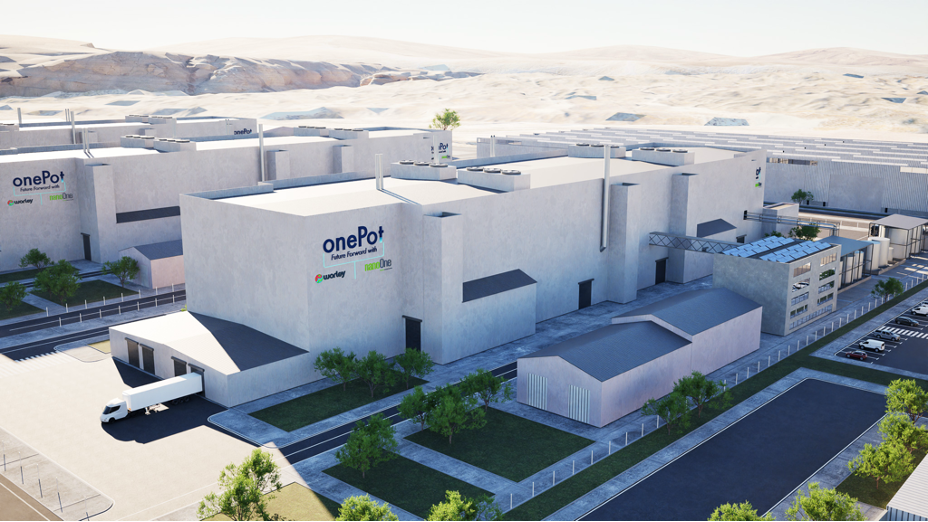
To talk a bit more about the science with Nano One, what Nano One brings to the table is really a process to make cathode active materials, which we call the One-Pot process. It’s a process proven to make LFP at commercial scale with a simpler, lower-cost process, with reduced impact and reduced risk compared to the existing technologies used in China. We’ve been working with Worley to bring that “design once, build many” approach, so we’re ready to deploy rapidly once the market is ready. We need to be able to deploy those plants.
We’ve advanced significantly on the engineering of large-scale production lines. We have pre-qualified equipment vendors and raw material suppliers, and that will enable faster investment decision-making when the time comes. The Candiac facility is really key to all of this. It provides commercial LFP right now for small-volume customers. It will also help deploy and prove the technology at scale, provide samples to pre-qualify customers for larger commercial lines, and bring commercial and operational know-how to support our licensing partners as they secure offtakes and commission their production plants. Our solution is really based on IP and know-how that we control, and we’ve designed that into our production line so we don’t depend on outside countries to bring it to market.
The market is just about to emerge and, honestly, explode. I think that’s what we see as well on the Worley side. We get involved in the delivery of many of these assets, not just in the LFP space, but across all sorts of cathodes and anodes. We would agree that localization of supply chains, certainly in the western world, Europe, and North America primarily, is only just starting to occur. It may have taken a little longer to form than people thought at the start of this decade, but it has certainly now started gaining momentum.
There is a ship yet to sail in terms of what else is available in the industry. Part of Worley’s strategy for our own growth in this industry has been to look at all the cathode technologies we saw emerging across the spectrum, regardless of where they were in the world and regardless of the chemistry they were focused on. We did our own internal review. We are process engineers. We understand the finer details of how these processes work, the equipment involved, and how much it costs to build and operate. Ultimately, that’s where we came to Nano One and said, “That looks pretty good. We’d like to get to know them and get a bit closer.” Here we are now, in partnership. Quite honestly, there is nothing else that I see that is as mature and as ready to be deployed.
This is something we’re already being asked about in our customer engagements. One part of Nano One’s business is selling a technology package. That includes the underlying rights or access to the IP, the flowsheet, the engineering, and the equipment that comes with it. There will still be a need for someone to complete the rest of the design and build the overall facility, which is typically what we would call the EPCM role. Yes, Worley can do that, but by no means does Worley need to be the organization doing it. It depends very much on what the customer is looking for, where in the world the facility is likely to be based, and whether there is a preference to use the synergies of Worley supplying the inside and also building the outside. In some cases, Worley may just supply the inside. It’s a “horses for courses” situation. We’re open to all of them.
We’ve seen this in our customer engagements. Some people may want the full package because they don’t have those resources and are newer to the market, so they want more support. Others already have dedicated EPCM teams. You see it a lot across different geographies and cultures. Some people are more open to the full approach, while others are not. We don’t want to limit it to saying, “You have to take the whole package.” The first thing we want to sell is really the technology.
On the complexity and cost side, this is a first-of-a-kind technology, so we’ve always taken the approach that we need to de-risk the scale-up. That’s what we’ve done and what we’re doing at Candiac. We have production-intent pieces of equipment making LFP today, tuning the process and the product, and interacting with target customers to meet their specifications. On the complexity side, we are able to demonstrate the technology at scale.
On the cost side, that’s why we’re working with Worley and key equipment vendors, to really nail down the cost of building a production line. On a cost-competitive specification outside of China, we feel quite confident that we are very competitive. It’s worth providing a little anecdotal evidence from some of the customer conversations we’re having. Some customers are looking at China and saying, “I can work with an EPC and get a turnkey LFP plant for X million dollars.” But they still have to rely on buying precursor, or PCAM, from China to build that. Then, when they get that direct equipment cost quote from the EPC, they have to start looking at localized requirements for permitting, equipment certification, installation costs, contingencies, building costs, and so on. Then they step back and realize the total cost is multiples of that initial quote.
That’s when they start looking at the One-Pot technology and engaging with us. They can see a fully integrated production system without reliance on PCAM from China, and a very cost-competitive process. That is the competition in a sense, but what you see on paper is not the reality of what people are experiencing.
From a chemical engineering perspective, what I look at is really the number of unit operations, because more equipment brings up costs, including CAPEX and energy. When I saw the One-Pot process for the first time, that’s what brought me to decide to join Nano One. I had been trying to make LFP for years. Making it was possible, but making it commercially competitive with China was very difficult. To compete with what they do in China, you cannot do it the same way. You have to do it a better way. That’s how I saw the One-Pot process.
The main differentiator with the One-Pot reaction is that we put everything in from the beginning of the reaction, and we don’t need to separate it. What comes out of the One-Pot reactor is sent straight to drying. That means no filtration, no byproduct, and no wastewater management. All of those unit operations used to handle something that is not really valuable are eliminated, so you save a lot of money there.
The other key differentiator is that because everything is already premixed, we spend a lot less time on what we call calcination, the last step of the process. Less time means simpler equipment, less space in the plant, less energy use, a lower carbon footprint, and lower cost. So the One-Pot process really lowers OPEX, CAPEX, energy use, and overall cost, making it competitive.
In addition to that, there is no reliance on controlled technology from China or raw materials from China. We keep talking about iron, but the iron sulfate used as the iron source in most processes in China today is not available at that scale outside of China. It is a byproduct of a titanium dioxide process that is not done the same way outside of China. So it’s simply not available. We have to do it differently, and that is a major differentiation that the One-Pot process brings.
What does “ready for business” mean right now? I think it’s simple. There are four things we needed to do: product, process, supply chain, and customers. We have reached a point where we have a process. We have a product. We have qualified raw material suppliers. And we have engaged cell manufacturers. So, we’re ready to go.
It’s a moving world, so there will always be improvements. We’ll keep improving. Specifications are moving, and we have to continue to adapt, but we are ready to go to market with what we have right now. That’s what we mean by “ready for business.”
The process we went through together to look at the existing Candiac facility, where the product is actually made, is key. We can take customers there and say, “It’s actually working at scale. We’re doing it.” Joint teams have looked at the design rules and tools to give them a boost. There is engineering behind it. There is safeguarding behind it. There is control philosophy behind it. The engineering work for the heart of the process is done, and we can put a price on it. We’ve completed an estimate and gone through everything together. When a real opportunity comes, all that needs to be looked at are the surrounding items: the local site, local requirements, and local utilities. But the heart of the process is designed, proven, and ready to be used.
That’s a really important point to hit home. It’s important for direct sales targeting, especially for defense applications, but also to show licensing target customers that we’re approaching that we have the technology at scale. Come in and see it. If you want a 25,000-tonne plant, it’s multiple versions of the same reactor, a couple of drying equipment pieces, and the calcination equipment on the back end.
Other things to look for include updates on existing partnerships and the path to sales. The work we’re doing with Worley on feasibility-level cost estimates for a production line is super important. The work we’re doing with key equipment vendors is also really important, because this is about taking six months or more of pre-qualification with that vendor, getting the technical specifications right, and getting strong quotes from them. That helps support the customer journey toward FID.
The market is continuously moving toward new grades of material. We have the base material. We have a product that is sellable, but the market moves. We’re really impressed with Nano One’s speed and technology knowledge to improve and expand on the product. From an engineering perspective, it’s relatively easy because we have the base case covered. From there, only the changes need to be examined. That might mean a little bit of extra engineering or a different vendor for a different piece of equipment, but the base is ready. From there, we can very easily and quickly move on to new developments and key development areas.
As the first ship sails, I think you will all be made well aware. We will be quite public about that. But there is still a ship yet to sail across this industry outside of Asia.
About Worley
Worley is a global professional services company of energy, chemicals and resources experts. We partner with customers to deliver projects and create value over the life of their assets. We bridge two worlds, moving towards more sustainable energy sources while helping to provide the energy, chemicals and resources needed now. Worley Limited is headquartered in Australia and listed on the Australian Securities Exchange (ASX: WOR).
About Nano One®
Nano One® Materials Corp. (Nano One) is a process technology company changing how cathode active materials (CAMs) are produced for lithium-ion batteries. Nano One’s platform is built on a portfolio of patented processes, decades of manufacturing know-how and modular plant designs that enable scalable, cost-competitive and easier-to-permit CAM production with resilient supply chains. The technology eliminates wastewater and byproducts while enabling regionally sourced raw materials and reducing exposure to foreign supply chain volatility. Modular plants are designed with fewer steps to reduce capex, energy and environmental intensity and to accelerate deployment, manufacturing and licensing. Product development and process optimization are based at Nano One’s Innovation Centre in Burnaby, British Columbia while piloting, demonstration and commercial production are based in Candiac, Québec, supported by a team with more than 15 years of commercial cathode manufacturing experience supplying global cell manufacturers. Strategic collaborations with global partners including Sumitomo Metal Mining, Rio Tinto and Worley support Nano One’s Design-One-Build-Many growth strategy. Nano One has received funding support from the Governments of Canada, the United States, Québec and British Columbia.
Disclaimer
This presentation is for informational purposes only and does not constitute investment advice or an offer or solicitation to buy or sell securities of Nano One Materials Corp. (“Nano One”).
Certain statements may constitute forward-looking information, including statements regarding market demand, partnerships, technical progress and commercialization. These statements are based on management’s current expectations and are subject to risks and uncertainties that could cause actual results to differ materially. Viewers should not place undue reliance on such statements and should consult their own professional advisors before making any investment decisions.
